by Tom Keer

There was so much dog hair on the stairs that I dang near slipped my way down to the coffee pot. I looked around and saw that it was everywhere. There was a pile of white fur in the corner by my bookcase, another bunch surrounded my desk and more was everywhere I looked. The date on my calendar said March 5, but I knew spring had already arrived. The “spring shedding season” was officially here.
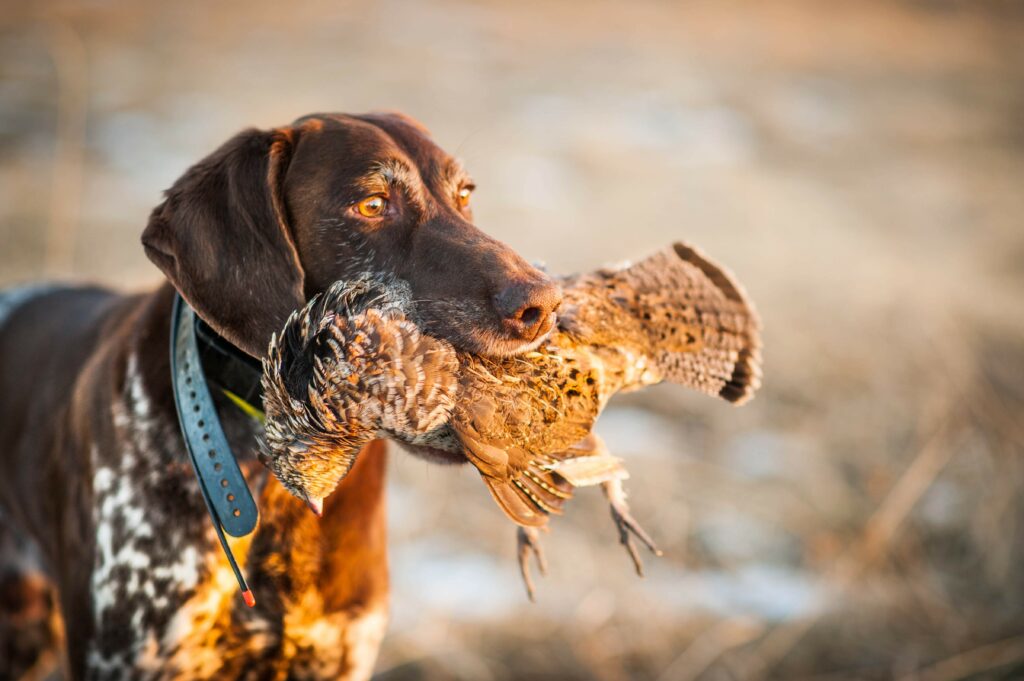
Owners of short-haired dogs are immune from the kind of pre-and-post hunt hair care that is common ground with long-haired breeds. Burdocks don’t care if they are entrenched in the fur of an English, Irish, red and white or Gordon setter. Cockleburs will climb aboard a springer as easily as they will a cocker or a Brit. Running Professor Longhair in the woods requires more care and maintenance that that of a skinhead – and it’s been that way for a very long time.
Long Hair, Don’t Care
A shag on point with his flag flying high is a stately sight, one that we’ve seen in countless paintings, in books and in magazine articles. Long-haired dogs have been part of grouse and woodcock hunting since Edmund Davis, the author of the 1908 book “Woodcock Shooting,” extolled their virtues. “One of the advantages of the setter is his long coat, which prevents briars from hurting him, and also protects him in the cold.” Coat color was also a factor, and Davis addressed that, too. “Black, white and tan I consider to be the best combination. It is easily seen in the thicket, and yet it is not too conspicuous. Lemon, liver and white – the blue Belton – any mixture will answer; but pure colors are not desirable. A black dog is hard to see. A pure white setter, although very beautiful, attracts too much attention, and some contend, alarms the birds. I shall not attempt to describe the different breeds of the setter. Let the sportsman select a well-bred, black, white and tan, and he will be content.”
There are two other absolute truths. First, to remove my hand from the check cord on my 95% white setter you’ll need to cut it off. And second, if you’re lacking good, humored conversation in camp then add the color discussion to the list. Start with, “It’s impossible to see a Gordon setter or a German shorthair pointer in the woods, especially in the early season.” You’ll exhaust those breed devotees otherwise. All kidding aside, it’s likely that Davis’s early hair-length points (pun intended) seem to have seeped into our attitudes. In a way, they’re passed down through the generations much like the genetics found in field trial champions.
Skin and Coat
Read the numbers on any bag of premium dog food and the percentage of protein is among the first that you’ll notice. The muscular physique seen on any breed of short-haired dogs comes from protein, but those amino acids are used elsewhere in the dog’s body, too. Protein is used to build a variety of cells that support many systems, but did you know that the dog’s largest body system, the skin and coat, consumes the most amount of protein? The dog’s skin and coat are his first line of defense against sickness, making Edmund Davis correct in saying that a setter’s coat protects him from the harsh environment in which our dogs work.
The Usual Suspects
Ruffed grouse are found in 38 of our 50 states, and that means long-hairs can get tangled up with a wide variety of seeds. Cockleburs are among the most common seeds found on our dogs – also known as beggar’s lice, stick tights or stickseed. Because they’ll stick to just about any kind of hair or clothing, my wife, Angela, calls them nature’s Velcro. They’re a member of the legume family that also include a variety of beans, and they’re hitching a ride so they can resow in a new area. Sometimes, we’ll see common or great burdocks as well as other sticky wickets like three-leafed tick trefoils, hedge parsley, and yellow avens. Enchanter’s nightshade is a unique name for sure, but I don’t think any seed has a more peculiar history than houndstooth. A few centuries ago, folks worried about getting attacked by dog-weaved necklaces from the stuff. In England and in the mid-1800s, doctors made a potion from houndstooth and believed it would cure venereal disease. Did the advent of penicillin render houndstooth obsolete? I don’t know …
All joking aside, prickly seeds can be a problem. Sure, they make dogs uncomfortable, for who wants to curl up and take a post-hunt snooze on a series of tines? It can become a real issue, especially with what we’ve all seen with our dirty dogs: self-grooming. Dogs with burrs stuck in their hair want to get them out. They’ll use saliva to wet the area and their tongues and teeth to pick away at burr. The problem comes if they ingest the burr and it gets stuck in their throat. Solving for that issue requires more time and money than just using a comb, a brush and a pair of blunt-tipped scissors to remove each one. If you forget your comb or brush, then just make one. All you have to do is to bend over the tines on a fork so they make a 90-degree angle. They’ll work just fine.
Those Little Bast#$@%ds
Unfortunately, many of you know what I’m talking about: ticks. On a white pointer you can spot ‘em right away. Dark-haired dogs are more challenging; however, it’s very difficult to spot those bloodsuckers on a dark-haired, long-haired dog. When running dogs in tick country, be sure they’ve gotten a Lyme vaccination that is augmented by a monthly chewable. I favor Simparica Trio, but other medications work well, too. If ticks are really bad, I’ll add two other procedures. The first is to spray my setters’ coats with Sawyer’s SP 624 Permethrin for Dogs. And if it’s a horrible year for ticks, then consider a post-hunt wash down with a flea and tick shampoo. This past year I pulled three, red-backed ticks from my own post-hunt hide. No damage was done, but maybe I should up my own personal anti-tick game, too.
Relationship Status: It’s Complicated
Edmund Davis believed that a dog’s thick coat helps him stay warm in the cold. There is a flip side to that coin, one that we talk about during the high heat and humidity on the front end of our season: heat dissipation. If a dog’s fur suit keeps him from getting cold, then surely it must contribute to his overheating, correct? Or does the fur serve as an insulator? No conclusive studies show a positive impact of a shaved long-haired dog on core body temperatures.
Hot dogs cool in one of three ways. The first, and primary method, is through panting. With panting, the dog exchanges their hot, internal air for cooler external air. Their intake of cooler air helps dogs regulate their body temperatures. There’s an issue, though, and that comes on a hot, humid, early season day. When hot internal air is swapped for hot external air, dogs don’t cool as well or as quickly.
Dogs cool in two other ways, too. One way is that they dissipate heat through their skin. Cooling through skin is why short-haired dogs are favored for hot regions, and it’s likely why you and I shave our shags. And, finally, and to a lesser degree, dogs cool through their paw pads. My Pennsylvania friend, Roger Hoover, wears short-sleeved shirts in the early season heat, saying that he’d rather bleed than be hot. Short-haired dogs can get cut more easily than long-haired dogs, so keep an eye on their skin and coat.
One year during shedding season, I looked at the hair-filled floors. They were so covered that I thought they’d clean up better with a shave than a sweep. That’s when I pitched out the concept of a short-haired dog to Angela. She had just concluded a 15-minute ponytail comb out so I figured I’d strike while the iron was hot.
“We should get a pointer,” I said. “That way we won’t have so much hair to clean up.”
“That’s a great idea,” she said. “Can you give me a ride into town this afternoon?”
“Sure thing,” I said. “But what do you need to do?”
“I just decided that it’s time for a change,” she said. “I’m going to get my ponytail lopped off.”
Some conversations end just as fast as they started, but talking about the best hair length for a grouse dog in camp? That ain’t one of ‘em.
Tom Keer owns The Keer Group, a marketing and public relations company that focuses on outdoor sports and recreation. He’s a writer, hunter and fisherman and a setter man.