
by Sean Barry | RGS & AWS Forest Conservation Coordinator, Southern Appalachians
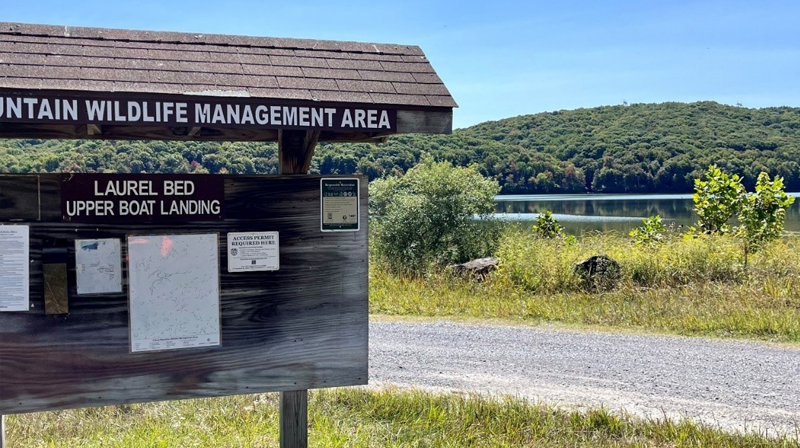
The faint change of leaves glistened along Laurel Bed Lake’s shore as early fall made itself vaguely known. One of those mornings that begins brisk and then warms up – a start in a jacket, end in a t-shirt type of day. The plan was to mark boundaries for a crop tree release at Clinch Mountain Wildlife Management Area (WMA) in southwest Virginia. This work is part of our project with the Virginia Department of Wildlife Resources and made possible with funding from the National Fish and Wildlife Foundation (NFWF). The goal of this crop tree release is to promote valuable trees for wildlife by reducing competition from other surrounding trees (see diagram Miller et al., n.d.) In our case, we’re looking to release oaks and hickories in stands roughly 20 to 30 years old. Other tree species of interest include cherry, service berry, black gum, flowering dogwood and magnolia. Although these stands are aging out of the early successional stage, promoting this combination of hard mast and soft mast producing tree and shrub species has a plethora of benefits for wildlife. Eventually, these mature forest stands will generate important food sources for many wildlife species and provide habitat for mature forest obligates like the wood thrush, one of the focal wildlife species for the NFWF grant.

Miller et al., n.d. “Technical Guide to Crop Tree Release in Hardwood Forests.” University of Tennessee Extension.
After a successful morning, Spencer Marshall, RGS & AWS Virginia forest wildlife specialist, and I made our way into the units in the higher elevation of the WMA. Following a fair amount of drive time up the windy old forest road, we both concluded that the area looked “grouse-y.” What was the giveaway? Mainly suitable cover alongside the road. Soon enough there they were – two grouse darting across the road into the younger adjacent stand. It’s amazing how quickly they can awkwardly run and then disappear into cover like they were never there. Not long after finishing up marking our final boundary of the day, another grouse flushed out from underneath the thick cover with that distinct flutter. Both sightings had a similar theme in common: elevation. All the grouse we spotted that day were right around 3,800 feet. Does this mean grouse can only be found at 3,800 feet in southwest Virginia? Not exactly. Grouse use different elevations and cover types throughout the year depending on the “physical and biotic resources” available. However, forest type and the corresponding elevation should certainly be considered when targeting focal areas for grouse, especially in the southern Appalachians.
Here are some notable points compiled from research and suggestions from management practices and strategies. While grouse can be found in a variety of forest types, they appear to be most abundant in northern hardwood, mixed-mesophytic and oak/hickory forests in the southern Appalachians. In northern hardwood forests, you’ll find species like sugar maple, beech, cherry and yellow birch. In mixed-mesophytic areas, look for many of the same species as above plus basswood, northern red oak, white pine, buckeye and sweet birch, to name a few. I’m sure you can guess what comprises an oak/hickory forest type; however, still be on the lookout for beech, hemlock and yellow pine species. According to Tirpak et al., mesic forests play a critical role in factoring “core area use” for grouse due to the widespread access to food and an advantageous microclimate. In addition to mesic sites, keep in mind other habitat features. For example, examine the forest structure and age class diversity present in the area. Look for areas with high stem density comprised of forests aged five to 20 years, 10 years being a good target, juxtaposed in areas with more mature hard mast-producing tree species like oaks and hickories. Find well-managed openings or old roads with native forbs or legumes. This interspersion of habitat types can provide more productive areas for grouse.
Ruffed grouse are a climate-sensitive bird and vulnerable to warming trends. Experts at Audubon predict this warming could continue to push their range further north, resulting in nearly a 35% loss of breeding range in roughly half a century (see maps from Audubon). With the southern Appalachians being the southernmost extent of the ruffed grouse’s range, we should be mindful of this trend and think about the implications it might have on the population over time. While grouse have many threats, the primary driver of their decline is a lack of suitable habitat, primarily a lack of young forest habitat. An interesting point to consider is, as the climate continues to change, so will the forests in the southern Appalachians. In fact, many tree species are expected to have to either adapt to new conditions or shift their ranges to more favorable environments in response to climate change. For this reason, grouse might be under additional stress from changing forest types, pushing them into new areas in the future. Forest types where you primarily find grouse today, might very well transform in the next few decades.

Forest types have certainly been altered over time through natural and anthropogenic causes, so this concept is not new or necessarily surprising. Look at red spruce in the central and southern Appalachians for example. Red spruce and spruce-fir ecozones used to be a major component of the landscape. Due to a period of intensive cutting many years ago and the widespread wildfires that followed, red spruce saw drastic declines and never recovered. It now makes up only a small portion of the landscape at the highest elevations, though it is part of a critical ecosystem for a number of flora and fauna. Grouse are known to be spotted in these high-elevation areas as well (see picture).

Why should we care? Spruce-fir ecosystems in the central and southern Appalachians are a good example of what can happen when we experience severe landscape-level changes. However, it also showcases the opportunity for restoration and collaboration. There’s renewed energy for spruce restoration in the region. The Nature Conservancy (TNC) convened the Red Spruce Technical Advisory Board (RSTAB), which works with technical experts like the Central Appalachian Spruce Restoration Initiative (CASRI) and the Southern Appalachian Spruce Restoration Initiative (SASRI). This collective group has provided recommendations to the U.S. Forest Service as they work on evaluating the Red Spruce Restoration Project, a multi-state, multi-forest partnership. TNC, along with partners in CASRI and SASRI, have been working on this issue for over 20 years. Millions of red spruce have been planted across thousands of acres targeting degraded pastures or previously mined lands on public and private lands.
Additional types of forest management are also implemented for spruce to thrive. Just as we do release treatments with hardwoods as mentioned above, spruce can also benefit from release treatments. These release treatments can be done commercially or non-commercially and usually involve work in spruce/hardwood forests where spruce in the midstory or understory is being suppressed. These releases can be done in areas with high potential for spruce while maintaining residual hardwood trees valuable to wildlife like cherry. This is just one example showcasing the importance of sustainable forest management to achieve desired conditions in areas that previously looked very different. I expect examples like this will become increasingly important to consider as climate change impacts the range of grouse and forest types in the southern Appalachians. Our management strategy must be fluid and dynamic to respond to these complex factors.

We are proud to call TNC one of our partner organizations in the region committed to achieving more diverse and resilient forests in Appalachia through their resilient and connected network. Our mutual intent is to work together on planning and implementing dynamic forest restoration blocks (focal areas) to benefit at-risk forest wildlife species, forest ecosystem health and the people of Appalachia. Partnerships like this are critical for getting work done across the region. We certainly can’t do it alone.
I hope this article has given you more information about the type of work we’re doing, where you might be able to find a grouse the next time you are in the woods, the importance of multiple forest management and stewardship strategies and the significance of partnerships for conservation work in the region. As conservationists who believe in healthy forests and abundant wildlife, taking a holistic approach to managing our forests to achieve desired future conditions is paramount for success.
Sean Barry serves as the forest conservation coordinator for the Southern Appalachian Region at the Ruffed Grouse Society & American Woodcock Society. In this role, Sean leads a range of conservation projects that promote healthy forests and abundant wildlife across Kentucky, Virginia, Tennessee, North Carolina, South Carolina and Georgia. Based in western North Carolina, Sean enjoys spending time in the mountains with his wife and dog.